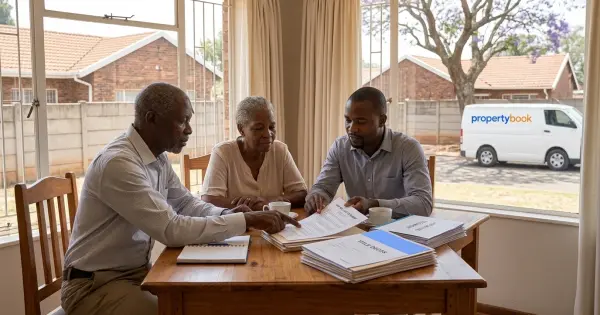
Buying a home together is one of the biggest financial decisions a couple can make. Yet many Zimbabweans buy property while living together without ever registering a marriage.
That raises a hard question. Who owns the property if the relationship ends, or if one partner dies?
The answer depends on several things: how the property was bought, whose name it is registered in, and whether the relationship counts as a civil partnership under Zimbabwean law.
A Civil Partnership Is Not a Marriage
The Marriages Act, 2022 [Chapter 5:17] introduced legal recognition of civil partnerships for the first time. You will still see this Act cited as Chapter 5:15 in older articles — the Chapter number was corrected to 5:17 by SI 141 of 2022.
Under section 41, a civil partnership can exist between a man and a woman who are both over 18, are not married to each other, are not related within the prohibited degrees, and who — looking at everything about the relationship — live together as a couple on a genuine domestic basis.
In deciding whether that is the case, a court may consider:
-
How long the relationship lasted
-
Whether the couple shared a home
-
Their financial arrangements, and how far each depended on the other
-
The ownership, use and acquisition of their property
-
Whether they cared for children together
-
The degree of mutual commitment to a shared life
Here is the part that gets misunderstood. This does not make the couple legally married. Section 41 gives the courts a framework for dividing property when the relationship ends. It is a property remedy, not a marriage. It does not give you the wider legal status of a spouse.
There is one more wrinkle worth knowing. Section 41(5) deals with the situation where one partner is legally married to someone else. In that case a court must protect the legal spouse's interests and cannot make an order over assets shown to belong properly to that spouse. In a country where these arrangements are common, this is not a small detail.
Whose Name Is on the Title Deed?
For property, the first question is usually whose name appears on the deed. If only one partner is registered as owner, that person generally has the stronger claim.
But it is not the end of the matter. If the other partner can show financial or non-financial contributions toward acquiring or improving the property, a court may weigh those contributions when resolving a dispute.
This is exactly why lawyers push unmarried couples to document what they put in — deposits, bond repayments, construction costs, renovations. Memory is not evidence. Receipts are.
Two examples show how differently this can play out.
Example 1: Buying a House Together
Shingai and Makanaka have lived together for eight years and never married. They saved jointly for a deposit, both contributed toward construction, and shared household expenses. The title deed, though, is in Shingai's name alone.
If the relationship ends, Makanaka can ask a court to recognise a civil partnership and to weigh her financial and non-financial contributions in deciding how the property's value should be shared. Whether she succeeds depends entirely on the facts and the evidence she can produce.
Example 2: One Partner Pays for Everything
Sammie moves into a house Keith bought years before they met. Keith alone pays the bond, the rates and the major maintenance. Sammie contributes to ordinary household costs.
If this relationship ends, Sammie will find it much harder to establish a claim on the property's value. The evidence points to the house having remained Keith's separate asset throughout.
Every case turns on its own facts. That is precisely why records matter.
What Happens If One Partner Dies?
This is where couples get hurt most often.
If an unmarried partner dies without a valid will, the surviving partner may not inherit the property the way a surviving spouse typically would. Section 41 is framed around dividing property when a relationship ends, and it does not give a surviving partner the automatic inheritance rights of a spouse. What happens next depends on the succession laws that apply, the ownership documents, and the circumstances of the relationship.
The fix is straightforward and cheap compared with the alternative. Write a valid will. It is the clearest way to make sure your property goes where you intend.
What the Courts Have Said About Contributions
Zimbabwean courts have long accepted that contributions to a relationship are not only financial.
In Usayi v Usayi (SC 11/03), the Supreme Court dealt directly with the value of a wife's domestic contribution. The court asked how anyone could put a monetary figure on decades of running a household and raising children, and made the point that this is exactly why the Matrimonial Causes Act speaks of direct and indirect contributions, including looking after the home and caring for the family. The wife was awarded 50% of the value of the house. The Supreme Court took the same approach again in Mhora v Mhora.
Those cases concerned married couples, not unmarried ones. But they show a settled judicial view that unpaid domestic work has real economic value. Section 41 of the Marriages Act invites courts to weigh both financial arrangements and shared domestic life when assessing a civil partnership, so the thinking carries across.
Practical Steps for Unmarried Couples
Whether you are buying your first home together or investing in property:
-
Decide upfront whether the property will be registered in one name or jointly, and write down why
-
Keep records of deposits, instalments and renovation costs
-
Record major financial contributions in writing at the time, not afterwards
-
Consider a written co-ownership agreement
-
Prepare valid wills, both of you
-
Get legal advice before buying high-value property together
None of this is unromantic. It is the same logic as insurance. You hope never to need it.
To Sum It All Up
Zimbabwe's law now recognises civil partnerships in a way it did not before. But recognition is narrow. It does not put every unmarried couple in the same position as a married one, and it does not solve what happens when someone dies.
For couples investing in property together, good records, proper documentation and honest conversation remain the best protection. Property is usually a family's largest investment. Understanding your rights today is how you protect it tomorrow.
This article is general information, not legal advice. Speak to a registered legal practitioner about your own circumstances.
Sources and References
-
Marriages Act, 2022 [Chapter 5:17], section 41 on civil partnerships — zimlii.org/akn/zw/act/2022/1/eng@2022-05-27 (Chapter number corrected from 5:15 by SI 141 of 2022)
-
Matrimonial Causes Act [Chapter 5:13], section 7 — zimlii.org
-
Usayi v Usayi (SC 11/03) 2003 (1) ZLR 684 (S) — zimlii.org
-
Mhora v Mhora — Supreme Court of Zimbabwe, on indirect contribution
-
Office of the Master of the High Court, Deceased Estates guidance. officeofthemaster.org.zw