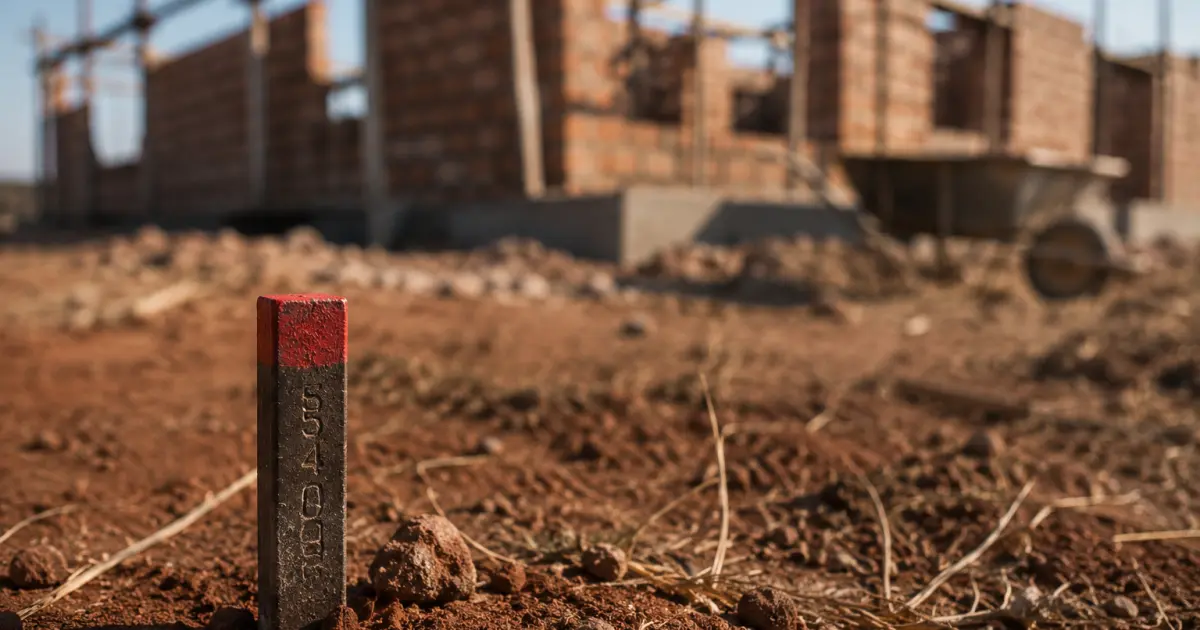
A man saves for fifteen years to buy a stand in Budiriro. He pays the cooperative. He gets an offer letter with stamps and signatures that look official. He builds slowly — foundation first, then walls, then a roof of zinc, one sheet at a time. He builds the way our fathers built.
Then one morning, a council bulldozer arrives at his gate. A forty-eight-hour notice is taped to the jacaranda tree. His investment, his sweat, his children's inheritance — gone. The council says the land was never his to buy.
This is not a story. It is happening, week by week, across Harare.
What is Happening, and Why
Since late 2024, the City of Harare has been on a demolition campaign. It is the largest such exercise since Operation Murambatsvina in 2005 — when, by the UN's count, some 700,000 Zimbabweans lost their homes, their livelihoods, or both¹.The current campaign is smaller in scale. But for the families inside the bulldozer's path, the loss is the same.
The numbers, as reported by The Sunday Mail and The Herald, are these. More than 5,000 houses face demolition. 37 High Court orders give the council the legal right to act². The targets are spread across the city.
In the high-density suburbs, the council has named Kuwadzana, Budiriro, Glen View, and Mabvuku³. In the low-density suburbs, Belvedere, Mabelreign, and Greendale have all seen demolitions⁴. The Harare Drive expansion route, according to a March 2025 Herald investigation, has placed another 200 properties at risk — in Retreat, Waterfalls, and even on land near the National Heroes Acre⁵.
The legal picture is mixed. The Constitutional Court has ruled that demolitions without a court order are unconstitutional. Local Government Minister Daniel Garwe has said no notice should be shorter than four months⁶. But the council does not always follow these rules. In April 2026, the council demolished tuckshops at Mabelreign Shopping Centre — and then it came out, in documents reported by Southerton Business Times, that the project had received council approval signed by the Acting Town Clerk only weeks before the bulldozers arrived⁷. If the council's own labels can change after the fact, no buyer can trust labels alone. He must do his own checking.
Three signs your stand may be at risk
Not every stand in every suburb on the demolition list is in danger. The threatened properties share a few clear features. If you understand them, you can tell the safe ground from the dangerous.
1. Who sold you the stand?
The court orders almost always target stands sold by cooperatives. According to the City of Harare's Regularisation Task Force report, as detailed in a Health Times investigation published in May 2025, more than thirty illegal cooperatives have been active in Budiriro alone — among them Takaitora Nyika, Parkridge, Ruvimbo, Bantu, United We Stand, and Excellence Stars⁸. The same report names Ebenezer, Chiedza Chedu, Totonga, and Northlands Housing GV Cooperative as having allocated land without authority since at least 2013.
Some of these names have a long paper trail in the courts. United We Stand Cooperative, for instance, has been the subject of formal High Court rulings going back more than a decade⁹.
The pattern is the same in case after case. These groups sold land they did not own. A cooperative is not the council. A cooperative offer letter is not a council-issued cession. A typed letter on letterhead that anyone with a printer can copy is not a legal title. If you bought your stand from a cooperative without going through council channels, your title is weak — no matter how many years you have lived there.
2. What is the land actually for?
The state has set aside certain land for certain purposes. Wetlands. Road reserves. School sites. Clinic sites. The path of the Harare Drive expansion. The expansion zone of the Robert Mugabe International Airport.
Anything built on this land is built on borrowed time. The High Court orders speak plainly on this. The Athenians, the builders of Great Zimbabwe, every people that ever built a city — all knew that some land belongs to all and cannot be sold to one. Build on the common land, and the city will, sooner or later, come for you.
3. What does your paperwork actually say?
The stands that survive scrutiny share a clean file. That file has an approved layout plan. An approved building plan. A council-issued cession or deed of transfer. Rates paid and up to date. A surveyor general's diagram registered against the property.
If your file has all of these, you can sleep. If your file has only a cooperative receipt and a man's word, you cannot.
How to check a Harare stand before you buy
The council has said the right thing: verify the status of any stand at district offices before you buy¹⁰. The advice is sound. But on its own, it is not enough.
A careful buyer will do all of the following.
Go to the district office in person. Ask, in writing, for confirmation that the stand exists in the council's records, that the seller is the registered holder, and that no demolition order or eviction is pending against the property.
Request a copy of the approved layout plan and the approved building plan. Compare what is on the paper with what is on the ground. If the plan shows three stands and the seller is offering you four, walk away.
Check the surveyor general's diagram. This sits outside the council and is much harder to forge.
Hire a conveyancer. Not the seller's lawyer. Your own. A good conveyancer will search the deeds registry, trace the chain of title, and draft a sale agreement that protects you.
Pay no deposit until the search is done. Pay nothing in cash that cannot be traced.
And trust no one. Not the cooperative chairman who says everyone has lived there for ten years without trouble. Not the agent who says paperwork is "in process." Not the relative who knows a man at the council. The Zimbabwean property market is not yet a place where trust alone is enough.
What You Owe Yourself
A guide to due diligence is not a substitute for a working city. But it is crucial nontheless. So, verify. Document. Walk away from the deal that is too cheap. Walk away from the offer letter that is too thin. Remember that a stand is not yours until the council, the courts, and the deeds registry all agree that it is.
That is a hard standard. In Harare today, it is the only one that will keep the bulldozer from your gate.
A note on sources
All cooperatives, officials, decisions, and figures referenced in this article are drawn from documented court records, government reports, and reporting by named Zimbabwean and international publications. This piece does not advance any allegation beyond what is already in the public record, and is intended as buyer-education guidance rather than commentary on any specific entity.
Sources
- Anna Tibaijuka, Report of the Fact-Finding Mission to Zimbabwe to Assess the Scope and Impact of Operation Murambatsvina, UN-HABITAT for the Secretary-General of the United Nations, 22 July 2005.
- "Harare to demolish 5,000 houses but . . ." The Sunday Mail, November 2024; "Harare begins city-wide house demolitions," The Sunday Mail, December 2024.
- "Harare begins city-wide house demolitions," The Sunday Mail, 1 December 2024.
- "Harare Demolitions Begin: Council Cracks Down on Over 160 Illegal Settlement Sites," Health Times, 15 May 2025; "Harare City Council halts house demolitions," Bulawayo24 News, 8 December 2024.
- "200 houses on Harare Drive face demolition," *The Herald*, 10 March 2025.
- "No demolition without four months' notice: Govt," The Herald, December 2024; "Govt stops Harare demolitions," NewsDay Zimbabwe, 18 November 2024.
- "Mafume Under Fire as Documents Reveal Mabelreign SME Project Had Council Approval," Southerton Business Times, April 2026.
- "Harare Demolitions Begin: Council Cracks Down on Over 160 Illegal Settlement Sites," Health Times, 15 May 2025, citing the City of Harare Regularisation Task Force report.
- Chitungwiza Municipality v United We Stand Co-operative & Fredrick Mabamba, High Court of Zimbabwe, HH 3-14, HC 10883/13.
- City of Harare, Department of Works and Planning, public advisory on stand verification, 2024–2025.