You're looking at cluster homes in Harare, and the price differences are confusing. According to the latest property data, the median price for properties in Borrowdale is $390,000, while cluster homes in Greendale have a median price of $220,000. Same bedrooms, same gated security, but a $170,000 gap.
What's driving this difference? And more importantly, which area gives you the best value?
This guide compares four major cluster home markets in Harare: Borrowdale, Greendale, Westgate, and Marlborough. We'll break down actual prices, infrastructure realities, and investment potential based on Propertybook's database of over 8,000 listings from 100+ real estate agencies across Zimbabwe.
Here's what matters most if you're buying a cluster home: you need to understand what you're paying for beyond the property itself. In 2025 "secure gated communities in Harare" saw a 23% increase in search volume on Google Zimbabwe over the past year. But not all cluster developments are equal. Infrastructure quality, HOA fees, and neighborhood dynamics vary significantly across suburbs.
What Makes Cluster Homes Different
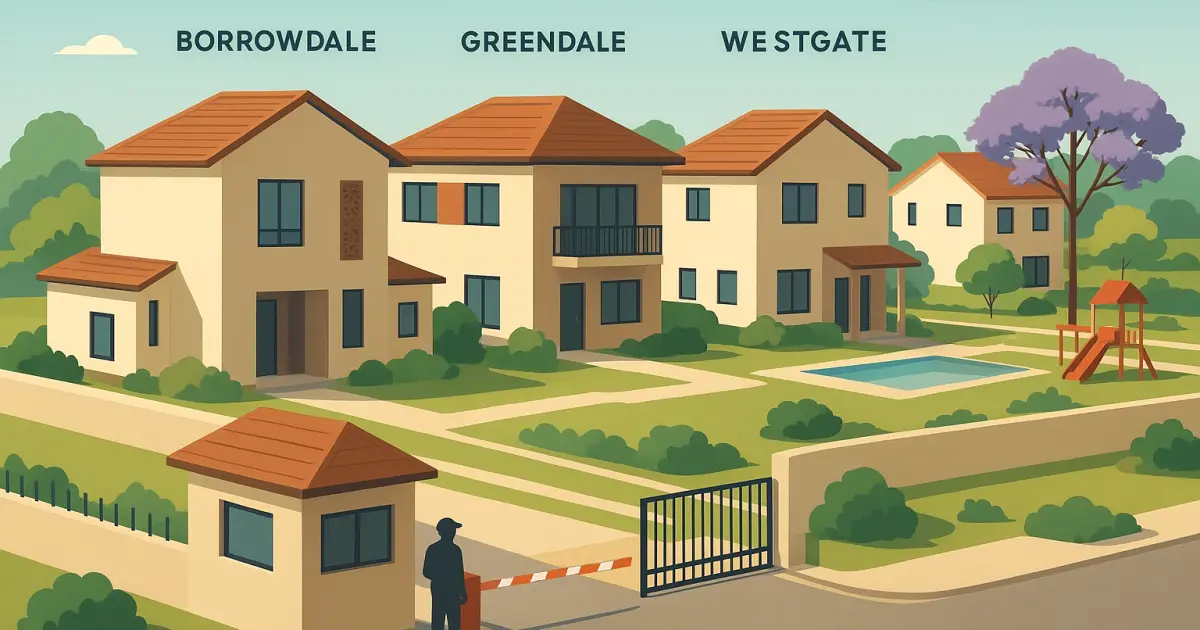
A cluster home is an individually owned house within a gated community where you get your own sectional title deed but share things like roads, security, and sometimes amenities with your neighbours. Each home typically sits on between 300 to 500 square meters according to local planning regulations.
The financial calculation is straightforward—add HOA fees to your monthly payment. Mortgages are almost nonexistent in Zimbabwe. But occassionally, the developer offers financing options after a 20% deposit. If a $120,000 cluster home costs $600 monthly in mortgage payments plus $100 in HOA fees, you're paying $700 total.
Three key differences from standalone houses:
Security is managed centrally. You don't hire your own guard or maintain your own perimeter wall. The complex handles this through HOA fees. Most developments feature 24/7 security, CCTV surveillance, and controlled access gates.
Maintenance is shared. Roads, common areas, and security infrastructure are maintained collectively. When the borehole pump or biodigester breaks or the access road needs resurfacing, costs are split among homeowners—sometimes through special assessments.
Stand sizes are smaller. While standalone houses in suburbs like Borrowdale often sit on 2,000+ square meters, cluster developments typically range from 250 to 500 square meters.
Browse cluster homes for sale across Harare
Borrowdale: The Premium Market
Borrowdale is a high-end suburb with an average cluster home price of USD 250,000, offering 300 sqm per property. However, Propertybook's current listing data shows prices for properties for sale in Borrowdale can vary greatly between USD 75,000 to USD 10,800,000 with a median of USD 390,000.
Borrowdale leads the market with high-end developments attracting upper-middle-income buyers. According to one listing, cluster homes in exclusive estates feature units set on generous 500 square meter stands.
The Borrowdale premium exists for concrete reasons. You're close to Sam Levy's Village and Borrowdale Village Walk, with top-rated schools like St. John's College and The Heritage School nearby.
Infrastructure is generally better here than other suburbs. Most complexes have backup water systems with large tanks and reliable boreholes. Solar installations are standard in newer developments.
But there are downsides. HOA fees in luxury developments can be substantial, particularly in complexes with pools, gyms, or extensive landscaping. Special assessments for major repairs hit harder in premium developments.
Who buys here: Established professionals, diaspora investors seeking premium rental yields, and families prioritizing school proximity.
Investment outlook: Borrowdale cluster homes maintain strong rental demand. Properties in this area command premium rents due to location and amenities.
Greendale: The Emerging Hotspot
The average price of properties currently listed in Greendale is $180,000. For cluster homes specifically, Propertybook data shows prices for townhouses/clusters in Greendale average from USD $190,000.
Greendale has seen a surge in cluster development recently. Some newly built clusters are priced at $272,000 for 4-bedroom units and $160,000 for 2-bedroom apartments.
Greendale occupies middle ground between Borrowdale's premium and more affordable suburbs. The area benefits from proximity to Honeydew Shopping Centre, which includes Food Lover's Market and various retail outlets. According to the nearby places data provided, The Three Monkeys restaurant rates 4.5 stars with 710 reviews, and Maize & Mingle Cafe rates 4.3 stars with 226 reviews.
Infrastructure presents mixed realities. Many newer developments incorporate solar systems and backup water tanks as standard. However, Greendale shares Harare's broader infrastructure challenges.
The suburb's rapid densification raises concerns. According to residents who petitioned council in December 2023, they rejected the cluster housing policy on the grounds that the City Council must first upgrade existing infrastructure including sewer, water and road infrastructures as well as social amenities to cater for an increasing population.
Who buys here: Young families with moderate household incomes, first-time buyers seeking affordability with good location, and investors targeting middle-income renters.
Investment outlook: Greendale maintains solid rental demand. Properties here attract middle-income tenants looking for security and convenience.
Westgate: Convenience at a Cost
Westgate's cluster market sits in a middle price range. The suburb's main selling point is proximity to Westgate Shopping Mall. According to the nearby places data provided, the mall rates 4.3 stars with 2,750 reviews and features supermarkets, restaurants, banking, and entertainment facilities.
Location drives Westgate's appeal. The shopping mall sits within walking distance of many developments, and major roads provide quick access to Harare CBD and other suburbs. Cyber City's growing office park nearby creates rental demand from professionals working in the area.
Stand sizes tend toward the smaller end of the spectrum. Some complexes feel cramped, with limited space between units.
Infrastructure quality varies by development age. Newer complexes built after 2022 typically include solar backup and substantial water storage. Older developments may require residents to install their own backup systems.
Who buys here: Working professionals prioritizing convenience over space, couples without children seeking lock-up-and-go properties, and investors targeting short-term or corporate rentals.
Investment outlook: Westgate maintains competitive rental yields due to strong demand from corporate relocations and professionals working at Cyber City.
Marlborough: The Entry Point
According to Propertybook's cluster home data, the average price of a cluster home in Harare North is US$240,000, compared to US$448,000 for a similar standalone house in the same area.
Marlborough cluster homes in turn cost around $140,000 compared to houses averaging $260,000. This illustrates how sharply prices drop when you move from Harare North to Harare West.
Marlborough delivers accessible entry into cluster home ownership. Several new developments cater specifically to first-time buyers with flexible payment terms.
The suburb lacks the retail concentration of Greendale or Westgate. Shopping requires a drive to neighboring areas. Schools and medical facilities are also less abundant than premium suburbs.
Infrastructure reliability is a concern. Municipal water and electricity supply follow the same unreliable patterns affecting most of Harare, and not all developments include comprehensive backup systems.
Who buys here: Young professionals and couples, first-time buyers prioritizing affordability and security, buyers seeking manageable monthly payments.
Investment outlook: Marlborough properties attract tenants seeking affordable cluster living with security. Rental yields are competitive despite lower property values.
Infrastructure Reality Check
Harare's infrastructure challenges affect every suburb. According to a research study on Harare's water supply, the City Council has faced numerous challenges in providing water for Harare residents, with the infrastructure unable to support the increased population since it was built many decades before 1980. Harare's population of 2 million is using services designed for perhaps 10 percent of that figure.
In August 2024, Harare Mayor Jacob Mafume told the Zimbabwe Independent that the city needs to upgrade over 9,000 kilometres of ageing water and sewer pipes, with an estimated cost of around US$800 million—well beyond the city's capacity given that residents collectively owe about US$100 million in unpaid rates.
What this means for cluster home buyers:
Water supply is unreliable. A 2019 Resident Association Report cited by researchers noted that 'The City of Harare is losing at least 60% out of the 450 mega litres generated through leakages and thefts of water along the water distribution network'.
Properties with comprehensive backup—borehole, large tank capacity (5,000+ liters), and proper distribution systems—command premium prices.
Electricity follows the same pattern. According to a 2024 Afrobarometer survey, only about one in seven Zimbabweans enjoy a reliable supply of electricity from the national grid, and among those connected to the grid, only four in 10 say their electricity works "most of the time" (34%) or "all of the time" (6%).
According to the same survey, half (50%) of those surveyed use sources of energy other than the national grid, among whom nine in 10 (89%) say they use solar panels. Solar installations have become standard in developments built after 2022.
Sewer infrastructure strains under densification. This affects newer cluster developments most acutely. Some complexes now use bio-digesters instead of connecting to municipal sewers.
Explore property listings in Harare CBD
HOA Fees: What You're Actually Paying For
"Properties with HOA services" are mentioned in nearly half of cluster home listings on property portals in Zimbabwe, as of Q1 2025. Monthly HOA fees vary depending on complex size and amenities.
Basic security (present in all developments): Guard salaries, gate control, perimeter wall maintenance. This typically accounts for 50-60% of HOA fees.
Shared infrastructure maintenance: Roads, lighting, refuse collection, borehole maintenance, water pump electricity. Another 25-30% of fees.
Amenities (premium complexes only): Pool maintenance, gym equipment, landscaping of common areas.
Reserve fund: Responsible HOAs maintain reserves for major repairs. Not all complexes do this properly, which leads to surprise special assessments.
Before buying, request to see the HOA's financial statements for the past two years. Look for consistent reserve fund growth, no pattern of special assessments, clear accounting of how fees are spent, and adequate funds for upcoming major repairs.
Making Your Decision
The "best" cluster area depends entirely on your specific circumstances:
Choose Borrowdale if: You have a substantial budget, prioritize premium schools and shopping, want maximum appreciation potential, and can afford higher HOA fees.
Choose Greendale if: You have $150,000 to $270,000 budget, want balance between affordability and location, prioritize proximity to shopping, and accept infrastructure concerns common to rapidly developing areas.
Choose Westgate if: You have mid-range budget, prioritize convenience over space, and want immediate access to shopping and entertainment.
Choose Marlborough if: You have $100,000 to $180,000 budget, are buying your first property, can handle less convenient location for affordability, and are comfortable with basic amenities.
Don't forget to factor in these additional costs beyond purchase price:
- HOA fees (vary by development)
- Property insurance
- Personal backup systems if complex doesn't provide them
- Special assessments
According to Propertybook's cluster buying guide, your initial outlay includes conveyancing fees of 3% of the property value, transfer duties and stamp duty combined typically adding another 4% to 6%, property valuation running $100 to $500, and structural inspection costing $150 to $400.
The Densification Controversy
Cluster developments face growing resistance from existing residents. According to The Standard's investigation, residents expressed concern about cluster housing projects sprouting in posh suburbs like Borrowdale, Mount Pleasant, Chisipite, Greendale and Highlands, fearing these developments will turn once elitist neighbourhoods into densely populated areas.
In December 2023, residents of Wards 17 and 19 rejected a cluster housing policy. According to Pindula News, residents rejected the policy on the grounds that the City Council must first upgrade existing infrastructure including sewer, water and road infrastructures as well as social amenities, such as schools and clinics, to cater for an increasing population.
The controversy hasn't stopped development. The Zimbabwe National Human Settlements Policy from 2020 encourages cluster projects. But it does mean you should verify that any complex you're considering has proper approvals and adequate infrastructure to support its density.
Investment Potential
Cluster developments offer manageable investment opportunities with the prospect of attractive rental yields, typically ranging from 6-9% per annum. That's slightly better than yields across Harare's broader property market.
According to a 2024 survey, 73% of homebuyers prioritize security when choosing a home, making gated cluster communities particularly attractive for rentals. This also makes them attractive to diaspora buyers, who often seek lock-up-and-go cluster properties.
Rental demand stays strong for cluster homes because young professionals want security and can't afford standalone houses.
The investment case for cluster homes rests on three factors:
- Lower entry cost than standalone houses makes them accessible to more buyers
- Security features maintain rental demand from professionals and families
- Lock-up-and-go convenience appeals to diaspora investors
But remember: HOA fees reduce net yields, special assessments can surprise you, and infrastructure problems affect resale value.
View more properties for sale in Harare South
Your Next Steps
Start by clarifying your budget—not just purchase price but monthly carrying costs including HOA fees. Then visit complexes in your target suburbs. Don't just view the individual unit. Walk the complex. Check the borehole, inspect the perimeter wall, look at road conditions.
Talk to existing residents if possible. They'll tell you about actual water reliability, how often special assessments happen, and whether the HOA manages finances responsibly.
Request documentation: HOA financial statements, complex rules, recent special assessment history, planned major repairs. Any well-run complex will provide this information readily.
Finally, work with registered estate agents who specialize in cluster developments. They understand the nuances of HOA structures, can verify development approvals, and help you avoid problematic complexes.
According to Propertybook's data, Harare dominates Zimbabwe's cluster market with around 300 townhouse complexes. Propertybook's platform features nearly 7,000 listings from 150+ agencies and developers across Zimbabwe. Use the filters to search specifically for cluster homes in your preferred suburbs and price range.
The cluster home market in Harare offers real opportunities for buyers who understand what they're getting into. The key is matching the right suburb to your specific needs and budget—then doing thorough due diligence on the individual complex before you buy.
Data current as of December 2025. All prices in USD. For the most current listings and prices, visit www.propertybook.co.zw.