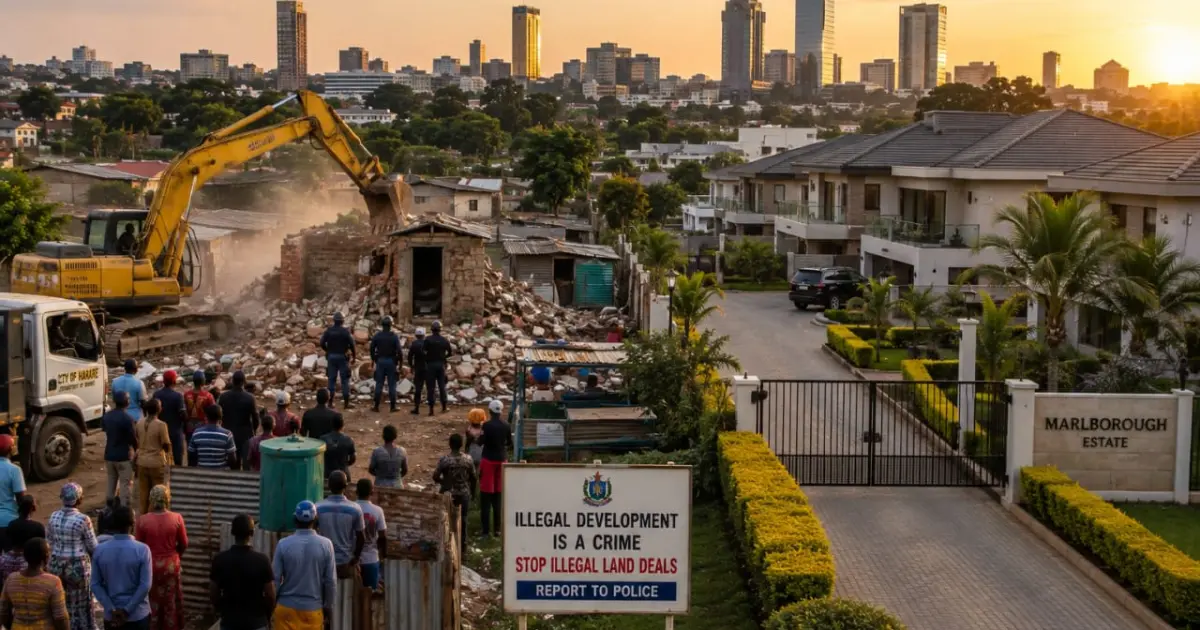
Harare’s property market is splitting into two realities.
In areas such as St Martins, authorities are demolishing structures linked to illegal land allocations and disputed sales. Residents are left asking how they lost homes they believed were legitimate. At the same time, upmarket suburbs such as Borrowdale, Mount Pleasant and Glen Lorne keep pulling strong demand for high-end homes, driven by diaspora income and foreign currency capital.
The contrast points to one issue. Demand for property is strong. Access to secure, legal land is not.
St Martins Brings The Land Question Back
Demolitions in St Martins have reignited the debate over illegal land sales and unauthorised building. On Friday 14 August 2026, the City of Harare demolished homes in St Martins Extension, along Airport Road opposite 1 Commando Barracks. The council said the operation covered both temporary and permanent structures and formed part of a wider campaign against unauthorised land occupations.
Residents disputed that. Some said they had been paying council rates and that their paperwork was in order.
Harare Mayor Jacob Mafume called the demolitions disheartening but defended them, urging residents with approved building plans to produce those plans during enforcement inspections. Harare South legislator Trymore Kanopula raised the matter in Parliament. He argued that the demolitions were carried out without court orders, and called for a moratorium pending a full audit of the affected areas.
The land history is messy. The council had pegged stands for the St Martins Housing Scheme along Airport Road. That followed an earlier approved plan being affected by a 200-metre statutory cantonment linked to the Zimbabwe National Army. A separate arrangement involving 333 stands and the National Building Society was later cancelled by the council. That added to the confusion over which allocations remained valid.
The council has also restated its regularisation position. The cut-off date for regularising properties remains 24 September 2023. Any land invasion or illegal development after that date will not be considered for regularisation.
The Land Baron Problem
At the core sits a simple question. Who has the legal right to sell land?
Illegal sales remain a major driver of urban housing disputes. In 2025, suspected land barons were arrested over fraud involving about US$320,000 from illegal stand sales. Government has since stepped up its warnings, with further crackdowns announced in 2026.
Demolitions only address part of the problem. Buyers often lose both the land and the buildings when the seller had no legal authority to sell in the first place.
Why Buyers Get Caught Out
Many buyers are misled by paperwork. An agreement of sale or an allocation letter looks official, but it does not prove ownership. Harare has previously warned about bogus cooperatives selling municipal land, including cases in St Martins where residents were told to report fraud.
The lesson for every buyer is short. Documents alone do not prove ownership. Verify ownership, approvals and legal authority before paying anything.
The council itself has urged home seekers to check the status of land and stands directly with the municipality. Approach the council’s housing department or the relevant district office before you buy or start building.
The Legal Question Behind Demolitions
Courts have stressed that demolitions must follow proper procedure. A 2025 Constitutional Court ruling reinforced limits on how authorities can remove structures without due process.
But two things are being argued at once. Whether a structure was built illegally, and whether a demolition was carried out lawfully, are separate questions. A resident can be right on the second point and still lose the house.
Propertybook tip: make sure you are compliant before you build, not after.
Harare’s Luxury Property Market Keeps Growing
While these disputes run, luxury real estate is expanding. Developments such as 2267 Lifestyle Estate in Glen Lorne and Arlington Estate off Airport Road are notable recent examples. Together with new projects inside already established suburbs, they show steady growth at the top of the market.
Borrowdale and Mount Pleasant operate in a different segment altogether, with mature infrastructure and high-value properties. Borrowdale’s median listing price sits at around US$495,000, reflecting strong investor demand. Propertybook data shows diaspora buyers account for about 30 percent of luxury transactions, with international investors adding another 5 percent.
Why Foreign Currency Matters
Remittances play a major role in Zimbabwe’s property market. The Reserve Bank of Zimbabwe reported that diaspora remittances reached US$2.45 billion in 2025, up about 14 percent on 2024. The United Kingdom narrowly overtook South Africa as the largest single source, sending about US$709.6 million against South Africa’s US$702.6 million.
That is a lot of hard currency landing in household hands each year, and a meaningful share of it goes into property. Diaspora and foreign buyers keep gaining buying power in high-value suburbs.
Part of the reason is what is missing. Ordinary citizens still have very limited access to housing finance. Mortgage lending accounts for only around 0.4 percent of GDP, a fraction of what you see in markets with deeper financial systems.
Cash Buyers Have The Advantage
Limited mortgage access means cash and foreign currency buyers dominate the top end. That creates a two-speed system. Cash buyers access premium homes. Everyone else relies on cheaper stands or informal schemes that carry far more risk.
In cases like the St Martins demolitions, ordinary citizens are the ones left coming to terms with the fact that their investment and their home are gone.
St Martins and the luxury boom reflect the same underlying issue. Land demand exceeds formal supply. Where the system fails, informal markets grow. Where capital is available, premium suburbs thrive.
Final Takeaway: A Market At A Crossroads
Harare has to balance affordable housing needs against demand for high-end property, while improving legal land delivery and enforcement. The St Martins demolitions show the risk of weak systems. Luxury growth shows real investment confidence.
Property value ultimately depends on legal certainty. Whether you are buying a stand or a luxury home, checking is not optional. In Zimbabwe’s property market, verified paperwork is protection.
Sources And References
-
NewsDay. “Mafume Breaks Silence On St Martins Demolitions,” August 2026. www.newsday.co.zw. Accessed August 2026.
-
NewZimbabwe.com. “MP Slams Harare Demolitions, Says Council Razed St Martins Houses Without Court Orders,” August 2026. www.newzimbabwe.com. Accessed August 2026.
-
The Standard. “St Martins Demolitions: There Must Be Consequences, Compensation And Heads Must Roll,” August 2026. www.thestandard.co.zw. Accessed August 2026.
-
The Herald. “Three Land Barons Arrested For Fraudulently Selling Stands,” 28 July 2025. www.herald.co.zw. Accessed August 2026.
-
NewZimbabwe.com. Government’s final warning to land barons, headmen and village heads, 30 July 2026. www.newzimbabwe.com. Accessed August 2026.
-
Reserve Bank of Zimbabwe. 2026 Monetary Policy Statement, diaspora remittance figures for 2025. www.rbz.co.zw. Accessed August 2026.
-
The Financial Gazette. “Zim Property Market In Context,” March 2026. Mortgage lending as a share of GDP. www.fingaz.co.zw. Accessed August 2026.
-
Propertybook. “Analysing Zimbabwe’s Luxury Property Market.” www.propertybook.co.zw. Accessed August 2026.
-
Propertybook. “Top 5 Suburbs Diaspora Buyers Are Watching In Zimbabwe, 2026.” www.propertybook.co.zw. Accessed August 2026.