If you're searching for property in Harare, you've probably seen "cluster home" listings and wondered what makes them different from regular houses. Maybe you're confused about pricing, worried about HOA fees, or just trying to figure out if this property type fits your needs.
Cluster homes now represent a small (around 6.5%) but rapidly growing portion of Harare's property market. It seems as though hundreds are cropping up each month.
In 2025, searches for secure gated communities increased by around 23%, showing how popular this housing option has become.
Here's the reality: cluster homes offer a middle ground between standalone houses and apartments. They're gaining ground because they solve real problems—security concerns, maintenance headaches, and affordability challenges that many Harare buyers face. However, as popular as they are, their contribution to densification, especially in regards to water and sewer reticulation, has led to resistance to the proliferation of cluster houses.
As Zimbabwe's largest property platform with 7,000+ listings from 150+ agencies and property developers, Propertybook has tracked significant shifts in how people buy cluster properties. Our data shows these homes typically cost $85,000 to $150,000 in Harare, making them more accessible than standalone houses that start around $180,000.
This analysis covers everything you need to know: what cluster homes actually are, how much they cost, what you'll pay in monthly fees, who's buying them, and whether they make sense as investments. We'll look at real numbers from Harare's market and give you the information to make a smart decision.
What Exactly Is a Cluster Home?
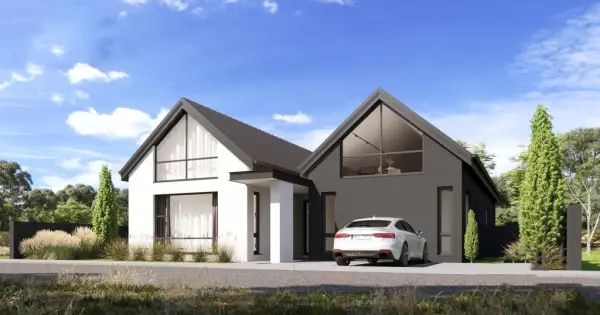
A cluster home is an individually owned house within a gated community that shares common infrastructure with other units. You get your own title deed, your own walls, and your own space—but you also share security, roads, and amenities with neighbors.
For standalone cluster units, the minimum land size per unit is 500 square meters. For semi-detached units sharing walls, the minimum area can be reduced to 300 square meters per unit. Most Harare developments have between 4 and 40 units, with the sweet spot being 8 to 16 homes per complex.
The key difference from a standalone house: you're part of a homeowners association that manages shared spaces and collects monthly fees. The difference from an apartment: you own the land, you have a yard (usually smaller), and you get more privacy.
Think of it as communal living with individual ownership. You maintain your own house, but the complex maintains shared roads, security gates, and perimeter walls.
How Cluster Homes Fit Into Harare's Market
Out of 3,391 properties currently listed in Harare through Propertybook's network, townhouses and cluster complexes make up 720 listings. That's seems small, but 21% of real estate in Harare is a significant figure. And it's rising rapidly.
Demand for cluster units has grown almost 30% year-on-year driven by buyers who want security, affordability, and low maintenance. The average property price in Harare is $310,000, but cluster homes typically sell for $180,000 to $270,000.
Here's the breakdown by bedroom count:
- 3-bedroom clusters average $176,000
- 4-bedroom clusters average $280,000
These prices sit between apartments (which average $144,000 for 1-2 bedrooms) and standalone houses (which average $293,000). You're paying more than an apartment but getting a house. You're paying less than a standalone house but giving up some independence.
The average 3-bedroom cluster home in Harare North costs $250,000, compared to $320,000 for a similar standalone house in the same area. That $70,000 difference matters when you're trying to get into the property market.
Find cluster homes for sale in Harare
Where You'll Find Cluster Developments
Cluster homes have spread across Harare, but certain areas have become hotspots:
Borrowdale leads the market with high-end developments averaging $379,000. Properties here typically sit on 500 square meters and attract upper-middle-income buyers. You're close to Sam Levy's Village (1.5 kilometers) and Borrowdale Village Walk (1.7 kilometers), with top-rated schools nearby like St. John's College and The Heritage School.
Marlborough offers mid-range options around $140,000 on 250 square meter plots. This area appeals to young families and first-time buyers looking for affordability without sacrificing location.
Bluff Hill sits in the middle at $98,000 average pricing, with developments on around 280 square meter stands. Several newly built complexes have appeared here, often marketed to diaspora buyers.
Greendale has seen a surge in cluster development recently. New complexes with 8 to 16 units are selling for $130,000 to $190,000, depending on finishes and stand sizes. Some even have up to 40, 4-bedroomed units that cost up to $270,000.
Highlands, Arlington, and Newlands feature upmarket developments, with some luxury clusters reaching $350,000 for 4-bedroom double-story units in exclusive complexes of 4 to 8 homes.
The pattern is clear: cluster homes work best in low-density suburbs where land costs make standalone houses expensive, but demand for houses (not apartments) remains strong.
What You Get in a Typical Cluster Home
Most Harare cluster homes follow a similar template. Walk through a development and you'll see 3 to 4 bedrooms as standard. The main bedroom usually has an ensuite bathroom. Built-in cupboards are universal.
Living spaces lean toward open-plan designs—combined lounge, dining, and kitchen areas. This modern layout appeals to young professionals and small families who want flow and light.
Nearly every cluster home includes:
- Fitted kitchen with built-in cupboards
- Tiled floors throughout
- Ceiling installation
- At least one bathroom plus a separate toilet
- Small private yard or garden
- Carport or garage for 1-2 vehicles
Utilities and backup systems have become selling points. 40% of cluster home listings mention shared boreholes, backup generators, or solar installations. Many developments now advertise 5,000-liter water tanks and solar geysers as standard.
Price per square meter in Harare averages $520, but cluster homes often fall in the $520 to $970 range depending on location and finishes. A 200 square meter cluster home at $520 per square meter would cost about $104,000—matching what we see in the market.
Security Features That Actually Matter
Security isn't just marketing talk for cluster homes. It's the main reason many buyers choose them.
73% of homebuyers prioritize security when choosing a home, according to ZimProperty Insights. Cluster developments deliver security in layers:
- Perimeter walls surround the entire complex, not just individual homes. You're looking at 2 to 3 meter walls topped with electric fencing or razor wire in most developments.
- Controlled access means a single guarded entrance for the whole complex. Some developments use boom gates, others have manned security posts, and newer ones are installing biometric systems.
- CCTV surveillance has become standard. Cluster developments often feature 24-hour security, guarded gates, CCTV surveillance, and perimeter walls creating a safer living environment.
- Shared security costs make professional security affordable. Instead of hiring a guard for one house (which costs $200 to $400 monthly), 10 homes split that cost to $20 to $40 each through HOA fees.
The security advantage is real. You can travel, work late, or live alone without the same level of concern you'd have in a standalone house.
Monthly Costs Beyond Your Terms Agreement
This is where cluster homes surprise people. You're not just paying off the terms you've agreed with the property developer that sold you your new home—you're paying the homeowners association every month.
Typical HOA fees range $50 to $150 monthly depending on complex amenities and management quality. Here's what those fees usually cover:
- Security services (guards, CCTV monitoring, access control)
- Refuse collection for the complex
- Maintenance of shared roads and driveways
- Upkeep of shared gardens and landscaping
- Exterior lighting for common areas
- Management company fees
- Reserve fund contributions for major repairs
A typical $100 monthly HOA fee breaks down roughly as:
- $40-50 for security
- $20-30 for refuse and maintenance
- $15-20 for management
- $10-15 for reserve fund
Some complexes charge as little as $50 if they only provide basic security and refuse collection. Luxury developments with pools, gyms, or extensive landscaping like the Borrowdale Brooke Estate can charge $200 or more.
You need to factor these costs into your budget. A cluster home with a $600 monthly mortgage becomes $700 with HOA fees—sometimes more if the complex offers premium amenities.
Special assessments can happen. If the complex needs a major repair—re-tarring the road, replacing the borehole pump, fixing the perimeter wall—the HOA might levy a one-time charge of $200 to $500 per home. This doesn't happen often, but it happens.
Who's Buying Cluster Homes in Harare
Three groups dominate cluster home purchases:
Young professionals and couples make up the largest segment. They're typically 28 to 40 years old, working in Harare, earning $1,500 to $4,000 monthly between them. They want security, they don't want yard work, and they need something more affordable than a standalone house. A $120,000 cluster home with a $30,000 deposit and terms over 36 months fits their budget.
Diaspora investors account for significant demand. Around 10 percent of property searches originate from the diaspora, with the UK, South Africa, Austrailia and the USA leading inquiries.
Diasporans want "lock-up-and-go" properties they can rent out or use when visiting Zimbabwe. Cluster homes work because security is managed, maintenance is handled, and renters appreciate gated communities.
Small families with 1 to 2 children find cluster homes practical. They get a house, a small yard for kids to play, and shared spaces where children can interact safely. The communities often have young families, creating a neighborhood feel that apartments lack.
Less common but growing: retirees who want to downsize from large standalone houses. They're trading yard maintenance and security concerns for a smaller, more manageable cluster home with HOA services.
Investment Potential and Rental Yields
Cluster homes work as investments, but you need realistic expectations.
Cluster developments offer manageable investment opportunities with the prospect of attractive rental yields, typically ranging from 6-9% per annum. That's slightly better than the 5-7% yields you'd see across Harare's broader property market.
Here's how the math works:
A $120,000 cluster home in Marlborough might rent for $700 monthly. That's $8,400 annually. Subtract $1,200 for HOA fees ($100 × 12 months) and you net $7,200. Your yield is 6%.
A $400,000 cluster home in Borrowdale might rent for $2,400 monthly ($28,800 annually). After $1,500 in HOA fees, you net $27,300—an 6.8% yield.
Rental demand stays strong for cluster homes because:
- Young professionals want security and can't afford standalone houses
- Expatriates prefer gated communities
- Small families choose houses over apartments when possible
Appreciation potential exists but varies by location. Borrowdale and Highlands cluster homes have appreciated 15-20% since 2022. Marlborough and Greendale have seen slower 8-12% growth. The market follows infrastructure—areas getting new shopping centers or road improvements see faster appreciation.
Challenges for investors include:
- HOA mismanagement can hurt property values
- Poorly maintained complexes struggle to attract tenants
- Oversupply in some areas (too many new developments) limits rent growth
The sweet spot: buy in established areas with good HOA management, keep the property well-maintained, and target tenants who value security and community.
Explore investment properties on Propertybook
Maintenance Advantages and HOA Rules
The maintenance story cuts both ways.
What you don't maintain: Roads, perimeter walls, security infrastructure, shared gardens, external lighting, drainage systems. The HOA handles all of this. Residents contribute to communal upkeep, which lowers individual costs for landscaping, refuse collection, and infrastructure repairs.
For someone who travels frequently or doesn't want weekend yard work, this is huge. You're not responsible for maintaining half an acre. You maintain your house and a small yard.
What you do maintain: Everything inside your perimeter wall. Your house structure, your plumbing, your electrical systems, your small garden, your driveway. This is standard homeownership.
The tradeoff: HOA rules. Most complexes have bylaws that control:
- Exterior paint colors (you can't just paint your house bright orange)
- Renovations and additions (you need HOA approval for extensions)
- Pets (some complexes restrict the number or type of animals)
- Parking (usually limited to designated spaces)
- Noise and conduct (typical community standards)
- Rental restrictions (some HOAs require tenant approval)
Read the bylaws before buying. If you want total freedom to modify your property, a cluster home will frustrate you. If you're fine with reasonable rules that keep the complex looking good, it's not an issue.
Legal and Title Considerations
Each unit will be on its own sectional title as an individual property that can be sold separately. This is critical. You're not buying shares in a company. You're buying real property with a title deed.
Sectional title means:
- You own your specific unit and the land it sits on
- You have voting rights in the HOA
- You can sell independently
- You can mortgage the property
- You have legal recourse if the HOA mismanages funds
Before buying, verify:
- Title deed is clear and registered at the Deeds Office
- Sectional plan is approved by the City of Harare
- Municipal approval for the development exists
- HOA is properly registered and has audited financials
Some developers sell cluster homes on "cession" (promise of future title transfer) while waiting for final approvals. This is riskier. You don't have full ownership until the title deed transfers. If you're buying on cession, work with a registered estate agent and a lawyer.
The Estate Agents Council of Zimbabwe regulates property transactions. Always use registered agents—you can verify registration through their website. Propertybook works exclusively with registered agencies to protect buyers.
Comparing Cluster Homes to Other Property Types
Let's be direct about trade-offs.
Cluster home vs. standalone house:
- Cluster: $120,000 average | Standalone: $180,000 average
- Cluster: 300-400 sqm land | Standalone: 1,000-2,000+ sqm land
- Cluster: HOA fees $100/month | Standalone: no HOA fees but higher security costs
- Cluster: shared security | Standalone: private security
- Cluster: HOA rules | Standalone: complete freedom
You're saving $60,000 but giving up land and independence.
Cluster home vs. apartment:
- Cluster: $120,000-150,000 | Apartment: $100,000-130,000
- Cluster: 3-4 bedrooms | Apartment: 2-3 bedrooms typical
- Cluster: private yard | Apartment: no yard
- Cluster: $100 HOA fees | Apartment: $80-120 levies
- Cluster: better rental yields | Apartment: lower maintenance
You're paying more but getting a house instead of a flat.
The cluster home occupies a specific niche: more affordable than a standalone house, more space than an apartment, more security than either option on your own.
Current Market Trends Affecting Cluster Homes
Several forces are reshaping Harare's cluster market right now.
Supply is increasing. As Harare pushes a "densification" agenda to accommodate more residents in the city, permit applications for cluster housing are usually approved if the land is properly zoned. The City of Harare is encouraging cluster development to address housing shortages.
More supply means more choice for buyers. It also means some areas risk oversupply, which would slow appreciation.
Regulatory changes are making development easier. Previously applications were denied for stands without municipal sewer access, but new council policy allows these projects using bio-digesters, opening more land for cluster development.
Modern features are becoming standard. Solar installations, backup water systems, and smart home features appear in newer developments. "Modern cluster houses" and "solar-powered homes" are trending phrases on social media platforms like Facebook Marketplace and TikTok Zimbabwe.
Resistance from existing residents is real in some areas. A NewZimbabwe.com survey found that 55% of existing homeowners are against densification efforts in their areas.
Concerns focus on infrastructure strain—water, sewers, and roads weren't designed for higher density.
This creates uncertainty. A cluster development might face neighbour opposition, delayed approvals, or infrastructure problems. Check the development's approval status and the City of Harare's infrastructure capacity before buying.
Diaspora demand remains strong. With 10% of searches coming from outside Zimbabwe, developers are targeting this market with turnkey solutions—fully finished homes that require no additional work.
Making the Decision
Cluster homes work for specific situations:
You're a good fit if you:
- Value security and are willing to pay for it
- Don't want extensive yard maintenance
- Need something more affordable than a standalone house
- Like the idea of a managed community
- Can accept HOA rules and fees
- Want better rental yields than standalone houses
You're not a good fit if you:
- Want complete control over your property
- Need a large yard
- Can't afford HOA fees on top of your mortgage
- Dislike community rules
- Want maximum privacy
- Plan extensive renovations
The financial calculation is straightforward. Add HOA fees to your monthly payment. If a $120,000 cluster home costs $600 monthly in mortgage payments plus $100 in HOA fees, you're paying $700 total. Compare that to a $180,000 standalone house at $900 monthly with no HOA fees but $150-200 in private security.
For investors, target 6-8% yields after HOA fees. Anything below 5% doesn't justify the effort. Anything above 9% probably signals high risk or poor location.
Final point: the HOA makes or breaks cluster living. Before buying, request financial statements from the HOA. Check if they have reserves for major repairs. Ask current residents about management quality. A well-run HOA protects your investment. A poorly run one destroys property values.
Cluster homes aren't perfect. They're a compromise. But for many Harare buyers—especially young professionals, diaspora investors, and small families—they solve more problems than they create.