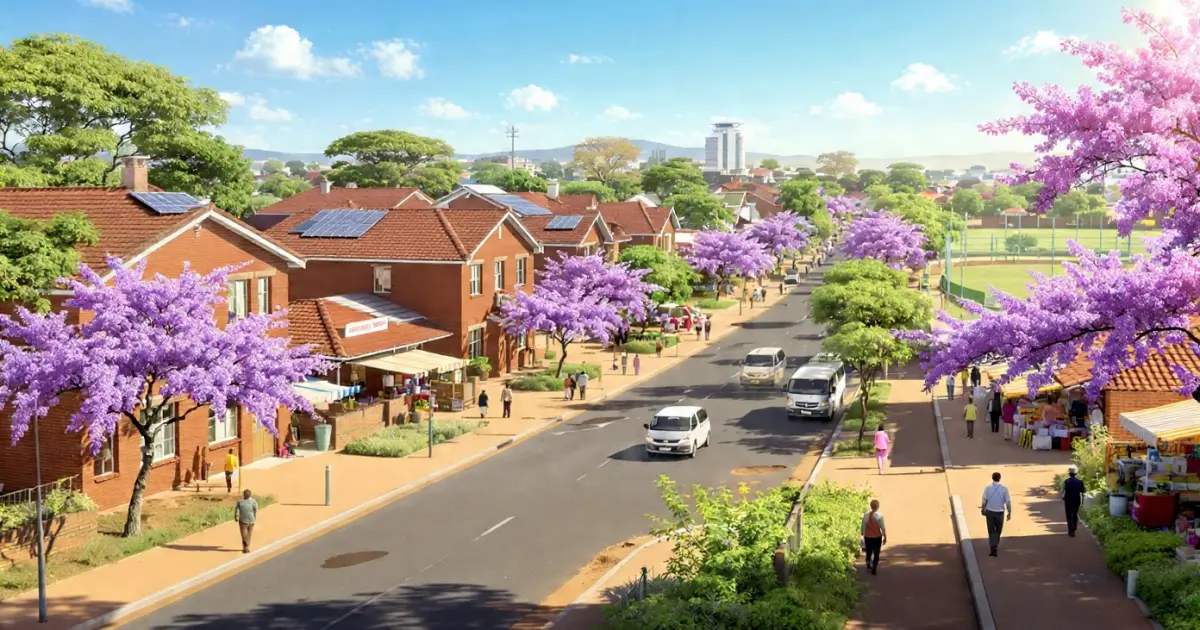
Buying or developing a home is usually presented as a question of four walls, a stand and a title deed. As Zimbabwe’s housing sector shifts, the definition of a successful residential development is getting much broader.
A house provides shelter. A working community needs a lot more. Residents need reliable water, roads they can use, sanitation, electricity, schools, healthcare, public spaces, shops and increasingly, access to jobs and public transport. This is where national housing and social amenities become a serious part of Zimbabwe’s property conversation.
The Ministry of National Housing and Social Amenities has set a vision of sustainable and affordable human settlements by 2030. Its mandate goes beyond housing to include social amenities and infrastructure in both urban and rural areas. The Ministry specifically lists schools, clinics, roads, bridges, water supply, rural electrification, sports and recreational facilities as part of the wider human settlement system.
For many buyers, a well-functioning community is reason enough to choose one property over another.
From Housing Units To Human Settlements
Zimbabwe’s housing challenge has traditionally been discussed as a numbers problem. How many houses are short? But the country’s own human settlements policy recognises that housing shortages come bundled with gaps in infrastructure and social amenities.
The Zimbabwe National Human Settlements Policy names the main challenges. They include weak on-site and off-site infrastructure, informal settlements, gaps between rural and urban areas, and the high cost of building materials and housing finance. It also calls for more sustainable and climate-resilient settlements.
A new residential area without proper roads, water or sewer infrastructure produces a collection of houses, not a neighbourhood. A well-planned development where homes are backed by essential services becomes a more attractive and more durable community.
UN-Habitat notes that rising urbanisation has put pressure on Zimbabwean local authorities, especially in meeting demand for housing, water and other services. The organisation has worked in Zimbabwe on urban governance, housing policy, urban planning, water and sanitation, and city resilience.
What Counts As A Social Amenity?
Social amenities are the services and facilities that let a community function beyond the individual home. They include:
-
Schools and early childhood development centres
-
Clinics and other healthcare facilities
-
Roads and public transport infrastructure
-
Shops, markets and commercial facilities
-
Recreational and sporting spaces
-
Community centres
-
Places of worship
-
Waste management services
-
Employment and small business facilities
The Ministry explicitly includes schools, clinics, roads, bridges, piped water, rural electrification and sports and recreation facilities in its social amenities responsibilities.
For developers, this means amenities should not be an afterthought. They can form part of the development proposition itself.
The Buyer’s Location Equation
Picture two houses with similar floor areas and similar asking prices.
The first sits in an older suburb with reliable access to roads, schools, shops, healthcare and public transport. The second sits in a newly developing area where the houses are attractive but residents still travel long distances for basic services.
On paper the properties look similar. In practice they offer two different lifestyles. The second property can also impose extra costs on the household through longer commutes, private transport, alternative water arrangements or other workarounds for missing infrastructure.
This is why buyers should look at the total cost of living in a location, rather than the purchase price alone.
That matters especially for diaspora buyers. A property can look affordable from overseas. But its location, infrastructure and access to services will shape the daily experience of the loved ones who actually live there.
Water And Sanitation Cannot Be Separated From Housing
Few amenities affect the quality of a residential development more than water and sanitation.
The 2022 Population and Housing Census gives a useful picture of the country’s uneven infrastructure. ZIMSTAT reported that 851,381 urban households, or 53.4 percent of urban households covered in the relevant analysis, had drinking water piped into their premises. In rural areas, boreholes and protected springs or wells were major sources, while a significant number of households relied on non-improved sources.
For a buyer, those statistics turn into practical questions:
-
Where does the development get its water?
-
What sanitation system serves the property?
-
Is the infrastructure already working, or only planned?
-
Who is responsible for maintaining it?
These questions matter as much as the size of the house.
Schools, Clinics And Commerce Shape A Neighbourhood
A successful residential development should not force residents to travel long distances for every basic service. Schools matter especially for families. Healthcare matters to households of all ages. Shops and commercial centres cut travel while creating openings for local businesses.
Swallowfields Gated Community in Norton is one example. Developed by Cape Valley Properties, the 1,550-stand project put in infrastructure such as roads, water and energy before families moved in. It also made room for schools, churches, a creche, a medical centre, a supermarket, a petrol station and commercial stands.
Swallowfields illustrates a broader principle. Residential development can be planned around a community’s daily needs, rather than treating each house as an isolated product.
Densification Could Change The Way Zimbabwe Builds Communities
Densification is another important part of Zimbabwe’s housing strategy. The National Human Settlements Policy recognises that land is finite and promotes better use of existing urban and peri-urban land. The Ministry has pointed to walk-up flats, multi-storey buildings, cluster housing and mixed-use developments as ways of getting more from urban land.
This connects directly to social amenities. Higher-density communities can bring more residents closer to schools, shops, transport routes and other services. Instead of pushing cities outward, well-planned densification helps existing infrastructure serve more people.
But density alone is not enough. More homes without enough water, sewer capacity, roads, schools, healthcare and open space simply moves the infrastructure problem somewhere else. The goal has to be well-planned density, not density for its own sake.
The Ministry’s policy direction supports integrating housing and social amenities, while encouraging partnerships between government, local authorities, communities, private developers and financial institutions.
What This Means For Developers
For developers, the growing emphasis on social amenities is both a responsibility and an opportunity. A development that can show reliable infrastructure and access to essential services has a stronger proposition than one selling only stand counts and house numbers.
Developers should think about the whole lifecycle of a community:
-
Who will maintain the roads?
-
How will water infrastructure be managed?
-
Where will residents access healthcare?
-
Where will children attend school?
-
Are there spaces for recreation?
-
Can residents reach local shops without travelling far?
-
How will waste be collected?
-
Can the infrastructure cope as the population grows?
These questions get more relevant as Zimbabwe moves towards more structured and integrated housing development.
A Practical Checklist Before Committing
Before buying in a new development, investigate:
-
Water. Confirm the source, capacity, reliability and who maintains it.
-
Roads. Find out whether roads are complete, still being built, or only proposed.
-
Sewer and sanitation. Understand the system serving the development and whether it is operational.
-
Electricity. Establish whether power infrastructure is already there and what connection arrangements apply.
-
Social amenities. Ask which schools, clinics, shops and recreational facilities exist or are planned.
-
Distance. Look beyond the development. How far is it from employment centres, major roads and established services?
-
Development plans. Ask to see the approved layout or master plan, and work out what is actually committed versus what is aspirational.
-
Responsibility. Determine who maintains communal infrastructure once residents move in.
This checklist helps separate a development that merely sells property from one that is building a community.
The Future Of Zimbabwean Housing
Zimbabwe’s housing story is entering a phase where the conversation has to move beyond counting houses. The real measure of progress should include the quality of the communities being created.
A house connected to reliable infrastructure is more useful than one without it. A development with schools, healthcare, commerce and recreation offers far more than an isolated collection of properties. A settlement planned with water, sanitation, transport, climate resilience and future population growth in mind stands a better chance of still working in twenty years.
The National Human Settlements Policy puts emphasis on access to land, security of tenure, densification, infrastructure, social amenities, climate change, new building technologies, urban regeneration and settlement financing.
That is what national housing and social amenities should mean for the property market. Not simply more houses, but better places to live.
For buyers, the lesson is straightforward. When you evaluate a property, look past the walls and the stand. Look at the neighbourhood, the infrastructure and the services around it. In the long run, it is not just the building you buy. It is the community you join.
Sources And References
-
Ministry of National Housing and Social Amenities. Vision, mandate, services, housing programmes and social amenities policy. www.nationalhousing.gov.zw. Accessed August 2026.
-
Ministry of National Housing and Social Amenities. “Zimbabwe National Human Settlements Policy Continues To Bear Fruit.” Swallowfields Gated Community, Norton, developed by Cape Valley Properties. www.nationalhousing.gov.zw. Accessed August 2026.
-
Zimbabwe National Human Settlements Policy. Government framework covering housing, infrastructure, social amenities, densification and sustainable settlements. www.nationalhousing.gov.zw. Accessed August 2026.
-
Zimbabwe National Statistics Agency (ZIMSTAT). 2022 Population and Housing Census. National data on housing conditions, water and household living conditions. www.zimstat.co.zw. Accessed August 2026.
-
UN-Habitat. Zimbabwe country programme. Background on urbanisation, housing, water, sanitation and urban governance. www.unhabitat.org. Accessed August 2026.