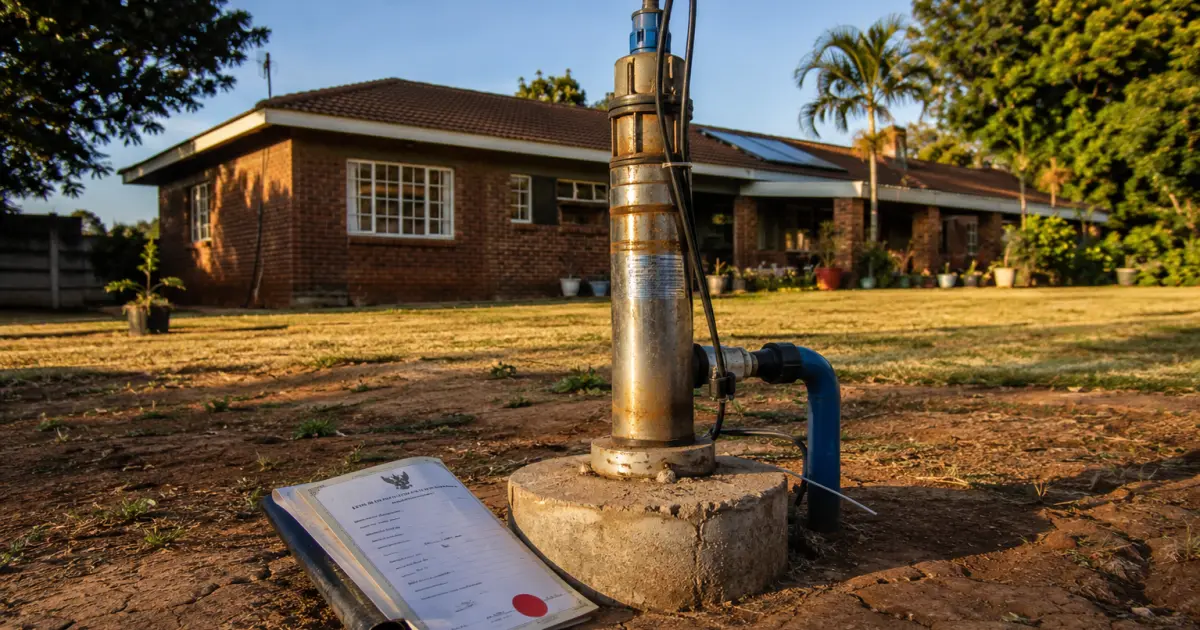
For years, drilling a borehole in Zimbabwe felt like a private decision. You had the land, you needed the water, you hired someone, they drilled, and that was that.
That era is over.
The Zimbabwean government and local councils are tightening borehole regulation fast. Enforcement is no longer a distant threat. If you own a borehole — or you're planning to drill one — here is what you need to know right now.
The Law Has Always Been There. Enforcement Is What's Changed.
It is illegal to drill a borehole in Zimbabwe without an Authority to Drill, and it is also illegal to abstract water without a valid permit. That is not new. According to the Water Act (Chapter 20:24) and Statutory Instrument 206 of 2001, registration is not optional — failure to register is illegal.
What has changed is that councils are now actually showing up, issuing notices, and collecting penalties.
In February 2025, Mbembesi sub-catchment council officer Genius Bunene wrote notices to villagers in Matabeleland North advising them of non-compliance, citing SI 291 of 2020 as read with the Water Act Chapter 20:24. Villagers in the Mbembesi area were hit with fines of up to US$205, which included a penalty fee, application fee, and registration fees.
The notice was explicit: every visit to your property would attract a non-compliance fee if you failed to respond within the stipulated timeframe, and the letter would serve as your first visit.
New Local By-Laws Are Raising the Stakes
Beyond the national framework, individual councils are now passing their own borehole by-laws — and the penalties they're setting are steep.
Statutory Instrument 191 of 2025 — the City of Masvingo (Wells and Boreholes) By-laws, 2025 — makes it an offence to drill a borehole within Masvingo city limits without prior council approval, with a contractor penalty of US$2,000 per incident for companies that drill without permission, as set out in the by-law's Second Schedule.
Statutory Instrument 177 of 2025 — the Insiza Rural District Council (Wells and Boreholes) By-laws, 2025 — similarly prohibits unauthorized drilling in the Insiza district. The by-laws empower council health officers to require water quality testing for any borehole supplying domestic water in areas without council water, and strictly prohibit cross-connections between private boreholes and council water mains. Non-compliant homeowners in Insiza face recurring US$300 inspection fines, and drilling is prohibited on residential stands smaller than 1,200 square metres.
An important point: these specific fine amounts — $300 and $2,000 — currently apply only within Masvingo and Insiza respectively. They are not yet blanket national figures. Individual municipalities have the legal right to set their own penalty schedules under the Urban Councils Act.
But here is the signal every property owner should read clearly: if Masvingo and Insiza are doing this today, your council may be next.
What Is National and Non-Negotiable
While penalty amounts vary by location, the underlying obligation does not. Across all of Zimbabwe, the national requirement — managed by ZINWA under the Water Act — is the same:
- All existing boreholes must be registered with ZINWA or the nearest sub-catchment council
- No new borehole may be drilled without prior drilling authority
- All prospective borehole owners must get a permit for drilling from ZINWA or the nearest catchment council office before work begins
For prospective borehole owners, the process includes submitting form GW1 to the sub-catchment council, with the appropriate fee, proof of land ownership, and a topographical map showing boundaries. Once drilled, a groundwater abstraction permit is also required, using form GW4.
If your borehole was drilled informally — no paperwork, no permit, no registration — it is non-compliant under national law regardless of where you live.
Why Government Is Moving in This Direction
This is not bureaucracy for its own sake. Zimbabwe has a groundwater problem that is quietly getting worse.
ZINWA has noted that groundwater levels have decreased significantly since 2015, and urban water demand is projected to increase by 50% by 2030.
The environmental case for stricter regulation is real. When thousands of boreholes are sunk in close proximity, each competing for the same underground water pocket, the water table inevitably drops — forcing the next person to drill deeper, until the most vulnerable are left with dry holes and dust.
One of the less-discussed consequences is land subsidence. When water is pumped out of the spaces between soil particles and rock, the ground loses its internal structural support and begins to compact — causing the land surface to sink, leading to cracked building foundations, warped roads, and snapped underground sewer lines.
There are public health concerns too. Municipal sewer systems in many urban areas are in a state of advanced decay, often running parallel to the very groundwater veins residents now rely on. When these pipes leak, the result is the invisible seepage of toxins into the water table — water that looks clean but may not be safe.
Regulation, done properly, protects everyone — including those who already have registered boreholes.
What This Means for Property Transactions
If you are buying or selling a property with a borehole, compliance is now a due diligence question.
An unregistered borehole on a property you're buying is a liability you're inheriting. One on a property you're selling is a potential disclosure risk. And for landlords and developers, the responsibility sits with you.
As local councils continue to gazette their own by-laws and penalty schedules, the question "is this borehole registered?" might become as routine as checking whether a title deed is clean.
What You Should Do Right Now
If you have an existing borehole that has never been registered, the smart move is to act before enforcement reaches you — not after.
- Visit your nearest ZINWA office or sub-catchment council to register your borehole
- Bring proof of ownership and the location details of the borehole
- Settle any outstanding levies and get your documentation in order
- If you are planning to drill a new borehole, obtain your drilling authority from ZINWA and local council approval before any work starts
All individuals, institutions, and organisations who may have drilled boreholes without the requisite documentation are advised to approach ZINWA or their respective Catchment Councils to regularise their water use.
The window to self-regularise is still open. An official notice might arrive along with penalties and fines.
The Bottom Line
Borehole ownership in Zimbabwe has shifted from informal to regulated. The national legal framework has always been there. What is new is that councils — from Masvingo to Insiza and beyond — are now building their own enforcement teeth on top of it, with real financial penalties attached.
The trend is clear. It is moving in one direction. And it is not slowing down.
Sources: Water Act [Chapter 20:24]; SI 191 of 2025 — City of Masvingo (Wells and Boreholes) By-laws; SI 177 of 2025 — Insiza RDC (Wells and Boreholes) By-laws; SI 168 of 2025 — Insiza RDC (Water, Sewerage and Drainage) By-laws; The Standard (March 2025); NewsDay (September 2024); Bulawayo24 (2025); The Zimbabwean (April 2026); ZINWA Groundwater Department
This article is for informational purposes only. Readers are advised to consult ZINWA (zinwa.co.zw) or a qualified legal practitioner for advice specific to their property or location.