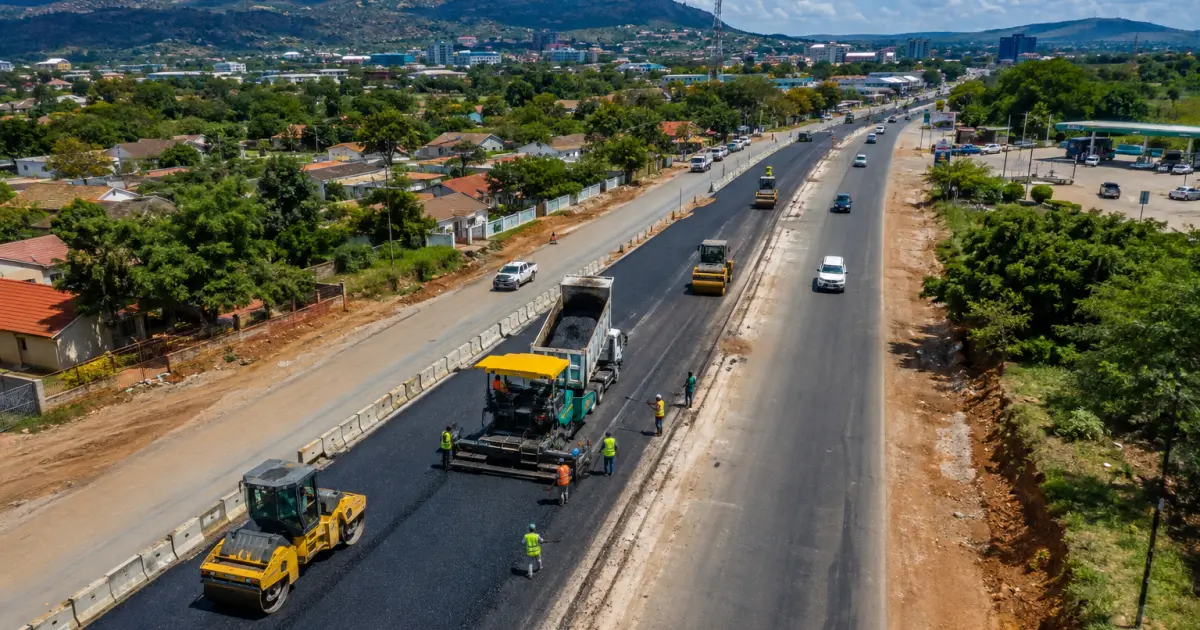
Zimbabwe’s road infrastructure is getting a major financial boost. The Zimbabwe National Road Administration (ZINARA) disbursed more than ZiG4.6 billion, roughly US$175.5 million, towards road maintenance in the first half of 2026.
That allocation represents 47.1 percent of the approved ZiG9.8 billion, or about US$363 million, set aside for road maintenance this year. That is a big step up from the same period in 2025. Back then road authorities had used about ZiG3.3 billion, or US$127 million. That was roughly 29 percent of the year’s maintenance budget.
For the property market, the significance goes well beyond potholes and resurfacing. Road infrastructure is one of the factors that decides how attractive a location becomes to homeowners, developers, tenants and investors. As maintenance picks up, better connectivity could change the appeal of established suburbs while supporting emerging residential and commercial corridors.
Why Road Infrastructure Matters To Property
A property can have an attractive house on a large stand with modern amenities, and still lose value to poor access.
For buyers, the condition of the surrounding roads affects commuting times, vehicle upkeep costs, access to schools and shops, and how quickly emergency services can reach the neighbourhood.
For developers, roads are even more basic. New residential developments depend on reliable routes connecting buyers to employment centres and essential services. Where roads are upgraded, areas that were previously hard to reach can become commercially viable. That matters in Zimbabwe, where urban expansion keeps pushing development past traditional city boundaries.
Nearly Half The Annual Maintenance Budget Released
ZINARA’s first-half performance suggests road authorities are receiving funding much faster than last year. ZINARA said the stronger flow of funds places the 2026 road maintenance programme firmly on course. The aim is to get money to road authorities in time to carry out planned maintenance and rehabilitation.
The funding is spread across different road authorities, so the impact will vary from place to place. The Department of Roads, which handles the national road network, received its full allocation of ZiG421.4 million, roughly US$16 million. The Rural Infrastructure Development Agency (RIDA) received ZiG115.1 million, about US$4.4 million, representing 47.3 percent of its annual allocation. RIDA has also used part of its funding to acquire 19 supervision vehicles to strengthen monitoring of rural road projects.
So the programme is not limited to major highways. Rural and regional connectivity forms an important part of the equation.
A Potential Boost For Emerging Property Corridors
As Zimbabwe’s property market expands beyond traditional centres, areas on the outskirts have attracted residential development. Buyers go there for larger stands and lower prices than established suburbs. But accessibility remains one of the biggest considerations, and a road upgrade can change that calculation.
Take a residential development several kilometres from an established suburb, reached by badly damaged access roads. Prospective buyers will factor in extra transport costs, longer commutes and vehicle wear. Upgrade the surrounding road network and the same development becomes far more attractive.
This is why infrastructure spending matters to property investors. A road project does not guarantee that prices will rise. But better connectivity strengthens the fundamentals of an area by making it easier for residents, businesses and services to operate there.
Harare And The Wider Metropolitan Market
Harare shows clearly why infrastructure and property development are intertwined. The capital keeps expanding outward as residential developments appear beyond the city’s traditional boundaries.
The 2026 national budget identifies several major road projects, including the Harare-Kanyemba and Harare-Chirundu corridors, alongside rehabilitation of arterial urban and rural roads. Government has also committed support for scheduled maintenance such as routine patching, crack sealing and resurfacing.
For buyers, the important question is not simply whether a road is being repaired. It is whether that road sits within the wider network. A road connecting a residential area to employment centres, commercial hubs or major highways has far more practical impact than an isolated improvement.
From Roads To Real Estate Value
Road improvements move property markets through several channels.
-
Accessibility. The most immediate benefit. Better roads cut travel times and make previously inconvenient locations more attractive to homeowners and tenants.
-
Development. Good infrastructure makes it easier for developers to build and market new projects. Construction companies, suppliers and service providers all operate more efficiently where access roads are reliable.
-
Rental demand. Tenants value convenience. A neighbourhood with reasonable access to workplaces, schools, shopping centres and public transport has stronger rental appeal than a similarly priced property in a poorly connected area.
-
Commercial activity. Better roads encourage businesses to set up along strategic corridors. As commercial activity grows, residential demand usually follows.
But Funding Is Not The Same As Completed Infrastructure
Here is the distinction property buyers should hold on to. Money disbursed is not the same as roads completed.
The latest figures show resources released to road authorities. The eventual impact depends on delivery, procurement, contractor performance, supervision and the quality of the finished work.
ZINARA’s own figures show how uneven that can be. Its weighbridge programme is meant to control overloaded vehicles that wreck roads. By 30 June it had spent only ZiG1.03 million, about US$40,000, against an approved budget of ZiG192.4 million, or US$7.4 million. That is 1 percent use.
The underlying challenge is large. Zimbabwe’s rural network is estimated at about 61,000 kilometres, more than 70 percent of the total road network, and heavy rains have worsened conditions in some areas.
The Parliament of Zimbabwe has also raised concerns about road authorities’ capacity to account for and use ZINARA funds. Government has said ZINARA disburses to urban councils on an acquittal basis, meaning further funding depends on authorities accounting for previous allocations.
For property owners, the takeaway is simple. Announcements about road funding should be followed by evidence of real work on the ground.
A Bigger Infrastructure Pipeline
The current push forms part of a wider effort to address Zimbabwe’s infrastructure deficit.
Since ERRP2 launched in 2021, more than 50,000 kilometres of road have been rehabilitated nationwide. Over 2,000 bridges and road structures have been repaired or upgraded. The full network is estimated at 84,000 kilometres. Government is now preparing a US$3 billion road programme targeting four key national highways between 2026 and 2030. It is outlined in the National Development Strategy 2 and will be delivered largely through public-private partnerships.
ZINARA’s own role is to collect and disburse road-user fees to road authorities for maintenance, rehabilitation and development. Vehicle licensing fees, toll fees, fuel levies and transit fees are the main sources of the Road Fund. That means the financing is tied closely to motorists and property owners alike.
More Tips For Property Buyers
If you are considering land or a home in an emerging area, road infrastructure belongs in your due diligence.
Examine the condition of existing roads, planned upgrades, proximity to major transport corridors, and whether surrounding infrastructure is keeping pace with residential development.
Also distinguish between a road announced for rehabilitation and a road where work has actually started. The difference can be significant.
For diaspora buyers this matters even more, because the purchase is usually made remotely. A development can look attractive in photographs and marketing material while the road infrastructure serving it tells a very different story.
Three things cut that risk. Inspect on the ground. Check infrastructure claims yourself. Read the local development plans.
Looking Ahead
ZINARA’s first-half disbursement is a real increase in resources flowing into road maintenance. The question is what happens next.
If the second half of 2026 sees road authorities convert funding into completed projects, the benefits will reach beyond motorists. Better roads improve access to housing, support economic activity and make emerging development corridors more visible.
For the property market, infrastructure is ultimately about connectivity. Neighbourhoods that become easier to service and better connected to employment and commercial centres become more attractive to buyers and tenants. Improved roads also lift investor confidence, because accessibility is good for business.
Sources And References
-
ZINARA. Disbursement report for the first half of 2026, covering allocations to road authorities and the weighbridge programme. www.zinara.co.zw. Accessed August 2026.
-
Bulawayo24. “Zinara Pours US$175 Million Into Roads But . . .” Disbursement figures, budget use and weighbridge spending. www.bulawayo24.com. Accessed August 2026.
-
The Herald. Reporting on ZINARA disbursements and road rehabilitation programmes. www.herald.co.zw. Accessed August 2026.
-
The Herald via Zimbabwe Situation. “Hre-Kanyemba Road Rehab Gains Momentum.” ERRP2 progress, network size and the 2026-2030 highway programme. Accessed August 2026.
-
Zimbabwe 2026 Approved Estimates of Expenditure. www.zimtreasury.co.zw. Accessed August 2026.